
Gurreet’s Painting
Project Write-Up
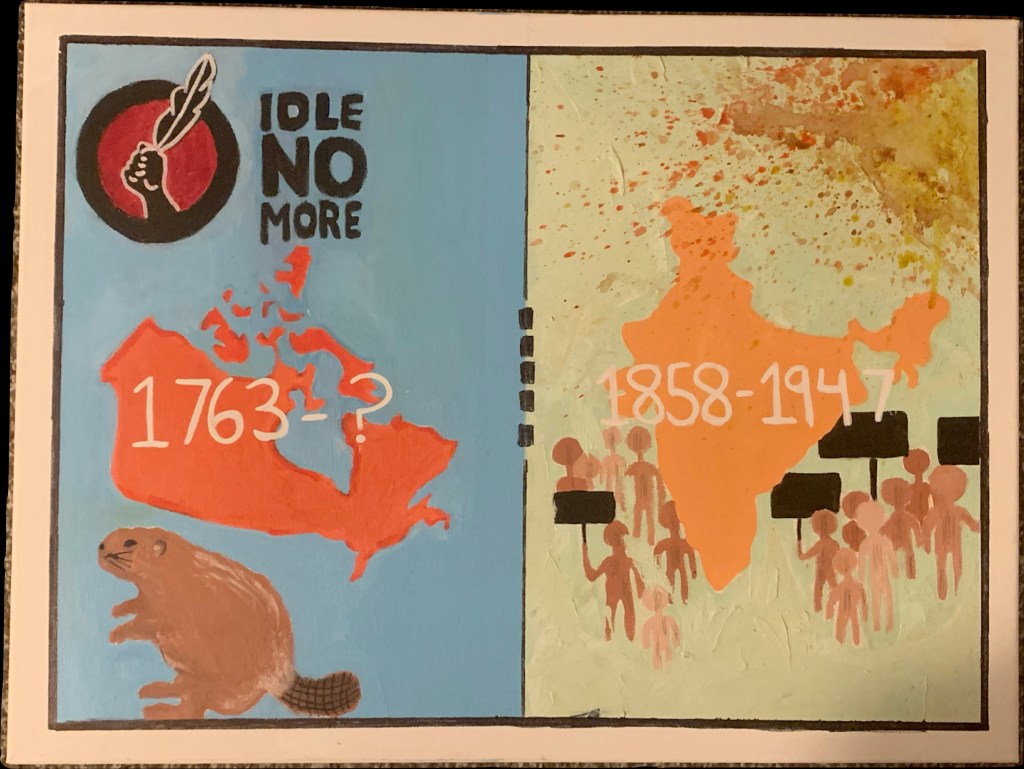
For my IIP project I did a painting that compares the British Colonization in the now known Canada to the British Colonization/ Raj that happened in India. My project displays the three main factors that I studied into depth to expand my knowledge on colonization in these two different places. In my painting I have shown resistance, the years of colonization, the land, and last but not least how the British got wealth from both sides. The left is Turtle Island or the now known Canada, the right is India/ Bharat.
I wanted to do these two countries because I was born and raised in Canada, so it is important for me to learn about the history of where I have grown up. I did India because I am originally from there and that is where I get my identity from. Not only was I invested in this project because it had connections with me but I also felt that the British Colonization methods were similar in most of the countries that they wanted to conquer and the ones I already had context about would make this project easier for me to present in front of the class.
Most of the things were similar between these two places but the one thing that was and still is different is that India has gained independence whereas Indigenous people are still under colonization. I have shown this in my painting by putting the starting date of when British Colonialism began on Turtle Island and then putting a dash which led to a question mark, portraying that we don’t know when this colonialism is going to come to an end.
Moving on to how I created this project. I mapped out my canvas and thought of all my placements and the different things I was going to draw within my painting. I made sure that each little detail in my painting had a meaning. For example I didn’t draw a straight line through the middle but did dashes to show the connection between the two colonized locations. The splatters of colours on the right side of the painting represent the spices that the British always wanted more and more of from India. I also chose to pick my colours with thought so nothing seemed off. I tried to make sure my colours went well with each other by trying to create a mixed but unique pallet. Then the rest I just painted and went with the flow.
In Conclusion my project was a way to show everyone that colonization is something that has very deep aspects to it, it affects each day of everyone’s life and who they are as a person. I wanted to show the similarities between these two lands that have experienced similar troubles/pains throughout the periods of British Colonization, but remember that the colonization in Canada has not ended yet and that is what we need to work towards resolving by choosing the path of reconciliation.
Alice’s Painting
Project Write-Up
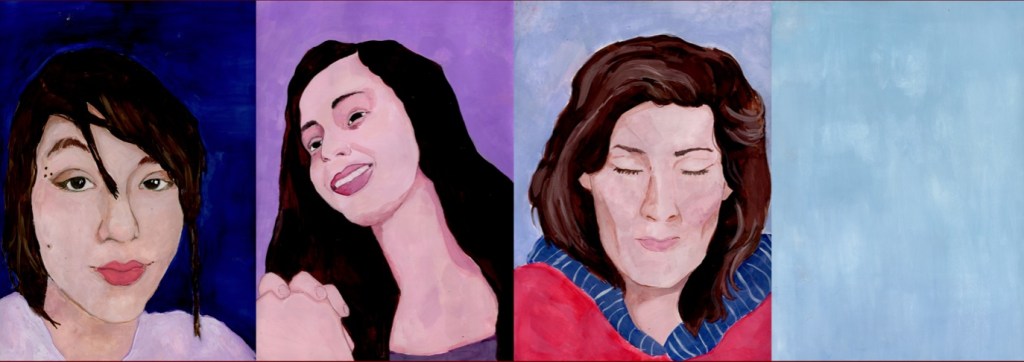
Indigenous women, girls, and Two-Spirit people are killed six times more than their non-Indigenous counterparts. At this point, we have all heard that statistic so frequently in the media that it has become separated from the people those numbers represent. When it comes to missing and murdered Indigenous women, girls, and Two-Spirit people, we ignore their humanity and the lives they lived while focusing only on the pure facts of their deaths. This became even more clear to me when, in the media, the names of Morgan Harris, Rebecca Contois, Marcedes Myran and Mashkode Bizhiki’ikwe were not said when discussing the trial of Jeremy Skibicki. The fact that four women with lives, passions, experiences, and families were reduced to simply victims in the public conscience is what inspired my Individual Inquiry Project. For my IIP project, I first looked into each of their lives, learned about who they were, and then painted each. This was my attempt to encourage people to have empathy for and give respect to MMIWG2S.
I started this project by gathering research on each of the women through news reporting on their killer’s case and the Search the Landfill movement. Once I felt like I knew enough about each woman, I would start their painting. Each painting took me anywhere from two to seven hours usually over several days. A part of this project that I struggled with was selecting the right photo to paint. There are only a few photos of these women available on the internet, and I wanted to choose a photo that I would be able to paint, that their family used for them, and that was not used on their missing person poster. This proved to not be possible in all situations, however I tried to be respectful and careful with the selections I made. The other major decision I had to make with this project was the correct way to represent Mashkode Bizhiki’ikwe or Buffalo Woman. She was the only unidentified victim, and I wanted to be able to represent her alongside Morgan Harris, Rebecca Contois and Marcedes Myran all of who have photos of and information about them online. For Buffalo Woman, I was originally planning on creating an abstract painting or a painting of an aspect of nature. Instead, I ended up creating a blank page. I chose not to try to represent her, because unlike the other women – anything I could do would be an assumption based on my biases of what an Indigenous woman looks like. These women were not protected because of the world’s biases and assumptions against them and I do not want to contribute to that.
Overall, putting this project together has reminded me to treat Indigenous women, girls, and Two-Spirit people who have been victimised as multidimensional people and more than just victims. I hope that the project has taught people the names and parts of the lives of Morgan Harris, Rebecca Contois, Marcedes Myran and Mashkode Bizhiki’ikwe and has encouraged increased empathy and awareness.
Sophia’s Poster

Project Write-Up
The reason I chose to do my project on constellation stories is because I like space, and science. Looking at the stars and astronomy is one of the earliest sciences, however, many of the observations made by Indigenous peoples were ignored or accredited to ‘real’ European scientists. While my project doesn’t dwell on science, by any means, I think it’s important to recognize how science has been done for a long time without recognition. My project is mostly about stories, another area I find fascinating, I find it crazy that all over the world people looked up at the night sky and saw pictures rather than random dots. However, most of the constellations and stories that we hear about are of Greek or Roman origin, and often aren’t applicable to us even geographically (i.e. A Greek constellation story hinges on the fact that the constellation is always near the horizon, while in Manitoba it’s high in the sky)! It’s also important to know constellations from more cultures and perspectives than just the Greek and Roman one. I also wanted to do this because I thought it would be really cool to present it, as I planned on using fairy lights to light up a painted night sky, and I do (occasionally) try to be artistic, and in this instance, I think it paid off, and went really well. I hope what I did goes on to teach others about different constellation stories than the ones they had probably already heard. To begin making it, I started by researching constellations to include, based on whether or not they could all be seen in the sky at the same time. Once I had compiled all of my research, I rewrote all the stories I wished to include in my own words. I then plotted out my star map on a piece of cardboard and punched out the holes for the fairy lights. Afterwards, I painted the cardboard over to look like the night sky, drew and then painted the outlines of the constellations, as well as added background stars. I then scavenged more cardboard to secure the night sky in an upright position. As soon as that was done, I fed the fairy lights through the holes and tapped them to the back of the cardboard. I then glued on the stories and the finishing touches. Some of the main challenges I had with this project was finding enough constellations with lots of things to write about that were all in the sky at the same time, I also struggled a bit with the medium itself, as the piece of cardboard I was working with folded over, and needed to be reinforced with Popsicle sticks. I also found it challenging to trace the outlines of the constellations as it is difficult to be so precise with a paint brush. Overall though, I had very few difficulties and the making of the project panned out smoother than I had planned for it to.
Maheder’s Poem
Project Write-Up
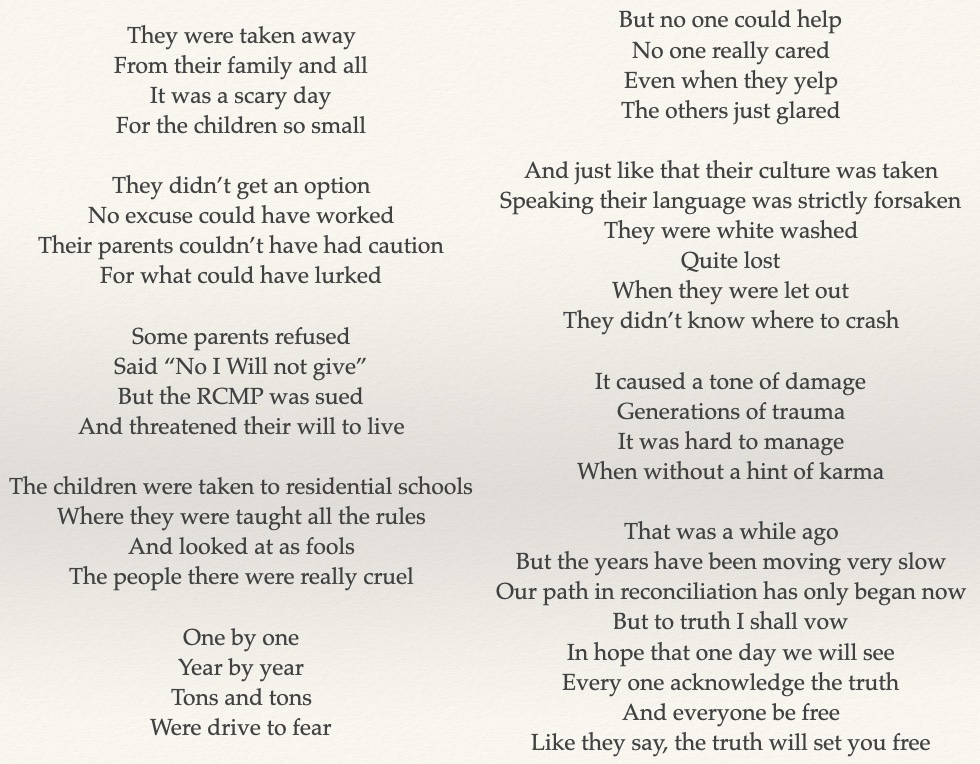
I chose to write an original poem for my individual inquiry project. The poem Is called “The Truth Will Set You Free” and it is about residential school, so basically a small summary of how Indigenous children were taken away from their home, taken to residential schools, how they were treated there, the trauma it caused, and where we are in reconciliation today. The name for my poem just came to me automatically after I finished writing the poem. My first research question was “How easily can indigenous language be translated to English?” and “How can a person with English as their only or main language translate an indigenous language without having no prior experience?” My idea was to write a poem, translate it to an indigenous language such as Ojibwe, then write that poem on a poster with an original background art that I would paint. Unfortunately, I could not find any online or easily accessible translators for indigenous languages, and also couldn’t find much information on it, so I couldn’t include that in my inquiry project. There was one online translating website that can translate many Indigenous languages, but it costs a lot. For one quote in an Indigenous language of Canada to be translated to English or vice-versa, the minimum charge is $500, so I was obviously not going to pay that much to translate the poem. So, i changed my research question to “ How did residential schools impact indigenous people” I chose to write a poem because it is something I have enjoyed doing since I was young, and also because I know that many Indigenous people write poems to express their hardships and generational trauma caused by residential schools and the sixties scoop. I didn’t necessarily want it to be on residential schools, but instead, wanted to write it on Tina Fontaine, however, I found it hard to gather a ton of information on her. To write the poem, I used everything I already know on residential schools to write a draft if it, then fact check it by looking for trustworthy and credible cites that say the same thing. If what I wrote is not true, I replace it with something else that IS true. Once the poem is finished, I got to painting the background of my poster (canvas). I used Indigenous art as inspiration, and used colours that represent something in Indigenous cultures. For example, I used yellow & orange which symbolizes the sun and wisdom, red, which usually represents war & courage, and black, which represents death. The background art is sort of like mandala art, which I have done before. I wanted to write the whole poem on the poster but there wasn’t enough space for me to do that, so instead, I wrote just the title in calligraphy. I chose calligraphy because it is one of the things I really enjoy and am good at. Although I usually don’t do calligraphy in paint with paintbrushes, I think I did a good job on it.
Ashveen’s Essay
Nadine’s Poster

Project Write-Up
or my IIP project I decided to go with MMIW awareness, to show awareness I created an art piece. For my art piece I knew from the beginning I wanted to show the women who were unfortunately one of many missing murdered indigenous women. To do this I created a collage of women in black and white in the background. Next I wanted to draw a traditional women dancer in her regalia because traditional dancers are very graceful and precise with their movement, also holding great honour when dancing. The connection to MMIW is that dancing in powwows can be healing and also sending up prayers to ancestors and passed away loved ones, ergo dancing to honour the MMIW and praying for their rest or to find stolen sisters. Next the colour scheme of the regalia is purple and blue. Purple in indigenous culture symbolizes connection to spirit, which I thing relates because if you lose someone close to you like a family member you guys are bonded in spirit. The blue in indigenous culture represents sorrow. So sorrow for lost loved ones and sorrow and sympathy for the others sisters who have been lost. I added a red hand print because it represents the missing and rude red indigenous women and girls across Canada but also to those who have or who almost got silenced. The red colour represents the life hood and connection one has with people, also its believed that red is the only colour that spirits can see therefore using the colour to call out the spirits of MMIWG back to their loved ones.
Next thing I did for me project is go into the statistics of missing murdered indigenous women and girls in Canada and some in Manitoba. I will name off a few of the more drastic information that shocked me. Indigenous women represent 10% of total population in Canada. And in 2014 the rate of indigenous homicide victims were six times higher then that of a non indigenous women. During the period 1991 and 2000 the cases of non indigenous homicides decrease but cases of indigenous women homicides stayed relatively the same. The rate of indigenous women going missing in Canada was 4.82 per 100,000. 50% of human trafficking in Canada are indigenous women. Following along with that indigenous women at ages 15 and older are 3.5 times more likely to experience violence compared to a non indigenous woman (and more severe violence). But what are the reason for some people seeing indigenous women as trash? And the reason I say trash is because when handled after death are just plainly related liking trash, example being Tina Fontaine. She was a 15 year old girl in Canada who was killed and put into a trash bag like trash to be forgotten about in the red river. One guy who murdered 4 indigenous women named, Jeremy Skibicki said that he thought he could get away with it because he thought “no one would miss them” only because they were vulnerable and got on the bad side of the Canadian governments system. He took it a step further to say that killing those women felt like “a lion…. With prey in its mouth.”
Harsimran’s Art
Project Write-Up
For my Individual Inquiry project, I have chosen to represent a successful indigenous role
model for someone to relate and look up to. In the media their indigenous people have been extremely underrepresented where we don’t see a lot of success stories but in the connately indigenous who have been murdered or convicted of a crime which creates this unreal stereotype about indigenous people if we are only seeing that bad.
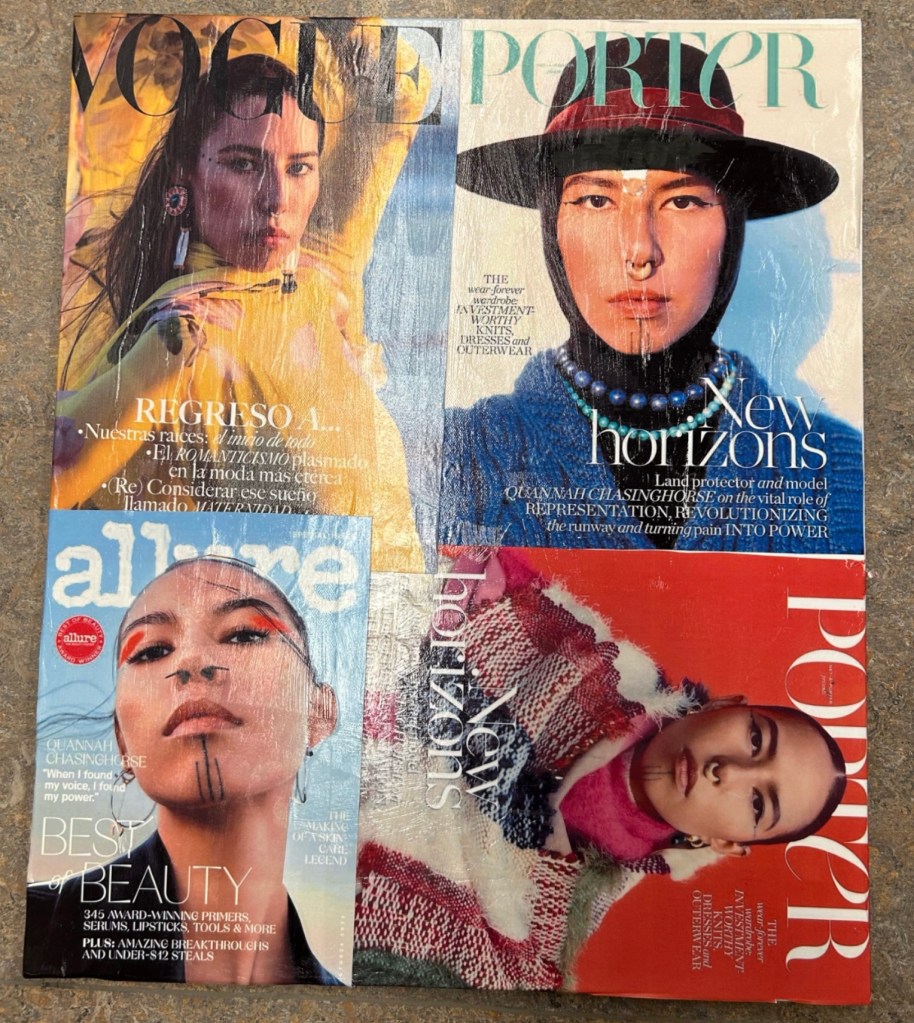
Quannah Chasing-horse is an indigenous model, actress and an activist for her people. Chasing horse shares Indigenous ancestors from both Canada and the United States where she grew up with many traditions in the house. She had been extremely passionate about fashion and watching the runway but seeing a lack of representation and ideal beauty standard. Quannah said, “it was really hard for me to feel like I had the potential to be a model”. Beauty is measured in many ways but being unable to see people who look like you or can relate to you continues that lack of representation. During our truth and reconciliation course we had seen a documentary about a girl having to scrub her skin because she believed it was dirty and she isn’t beautiful due to the beauty standards set by the Europeans. Now in time we’re trying to reconcile by creating a wide diversity of all different races and ethnicity we can break down barriers. In the 90s that conducted the “doll test” with children had to choose between two different Barbies with everything being the same except the color of their skin. Although this experiment had been
Boparai 1
associated with the psychological effects of segregation on African American’s I feel like indigenous kids can also relate to it due to residential schools. Every single kid had chosen the white Barbie because they thought it was prettier, and the black doll was bad somehow, and the study proved that children’s felt as if they were inferior. Now we are seeing a change where Barbies who are wearing ribbon dresses and letting children have something which is shaped like them. In high fashion, we have Quannah chasing horse who embraces traditional tattoos, which is a practice that dates backs 1000 years. This breaks the stereotypes that models are blank canvases but instead she displays the lines on her chin and the corner of her eyes. Which for her the lines represent the overcoming generalization and personal trauma. Bring back that tattoo is something which is important to her because it feels empowering, and she can be carrying on sacred traditions.
Having a wide diversity of traditions and showing that indigenous people are just like normal people. To the path of reconciliation, we can work on the lack of representation and ideal beauty standard to inspire the younger generation to come.
Tanvee’s Agamograph
Project Write-Up
The main goal of my project was to create an artwork that showcases the impacts and the aftermath of events that went down in Canadian history that solely related to Indigenous people. Such events consisted of the cruel reign of residential schools, the times when settlers colonized Indigenous lands, and the on going event of Missing and Murdered Indigenous girls, women, and two spirted. Each time we would discuss an event where Indigenous communities throughout Canada have had negative impacts on the majority of their population, I would be astounded. Incidents like when I was reading a book with my class a few years ago and reading how many Indigenous people were brutally killed when colonizers took over the land inspired me to bring attention to just how many people were killed. They would give Indigenous communities blankets infected with the horrid diseases, such as smallpox, on purpose so that their population can die off. Because of their gruesome acts, 90% of the indigenous population in North America were killed. Another example of an incident that brought me to doing the concept I’m doing for my project was when watching the film “We Were Children”. I was so taken aback of the treatment of the children who used to go there. Those sad days of when families of those children just impatiently waiting for their children to return back to them, only for their emotions to be replaced with those of sorrow and grief. Those families weren’t even let known of the fact their child has died. These kids were abused in many ways and starved till death and even intergenerational trauma occurred among the future generations of these children. Even after their years spent at the residential schools, some people contemplated committing suicide and faced mental health problems. These two incidents inspired me to articulate the impacts of both colonization and residential schools in an artful manner.
At first I decided I would just do a painting of impacts on these two events only. Almost like my current project, paint a person before they attended a residential school or before their community/land was colonized and kind of blend into the aftermath of these people after these events. I would’ve done all this on a poster and just left it at that. But I wasn’t quite satisfied with my idea. Then came the day of the blanket exercise and Viola Plett presented and talked about the missing and murdered Indigenous women and two spirted.
I didn’t know too much of it then but Viola educated me and others on this pressing issue. In Mr. Grusko’s rotation for this course, I chose a movement for a research assignment and that movement helped Indigenous families who are suffering from their loved one being murdered or missing. These families go through so much emotional and financial strain after their family member has gone missing or has been murdered and no investigation nor help is being provided by the government whatsoever. So this movement (Families of Sisters in Spirts) helps these families through these tough times and that very much inspired me into doing a painting on this issue too. So I had three topics in mind to represent the impacts of these events. And now I was also contemplating if I want to do a simple painting representing the impacts. For some coincidence, I came across a video of this girl doing a painting then cutting it up then gluing the two painting together. She folded it up and on one side there was a picture of something and when you moved to the other side, it changed completely into something else! That craft she did is called a agamograph and I was determined to represent the impacts of all these events by doing a agamograpgh!
 Gr. 9 Truth & Reconciliation